
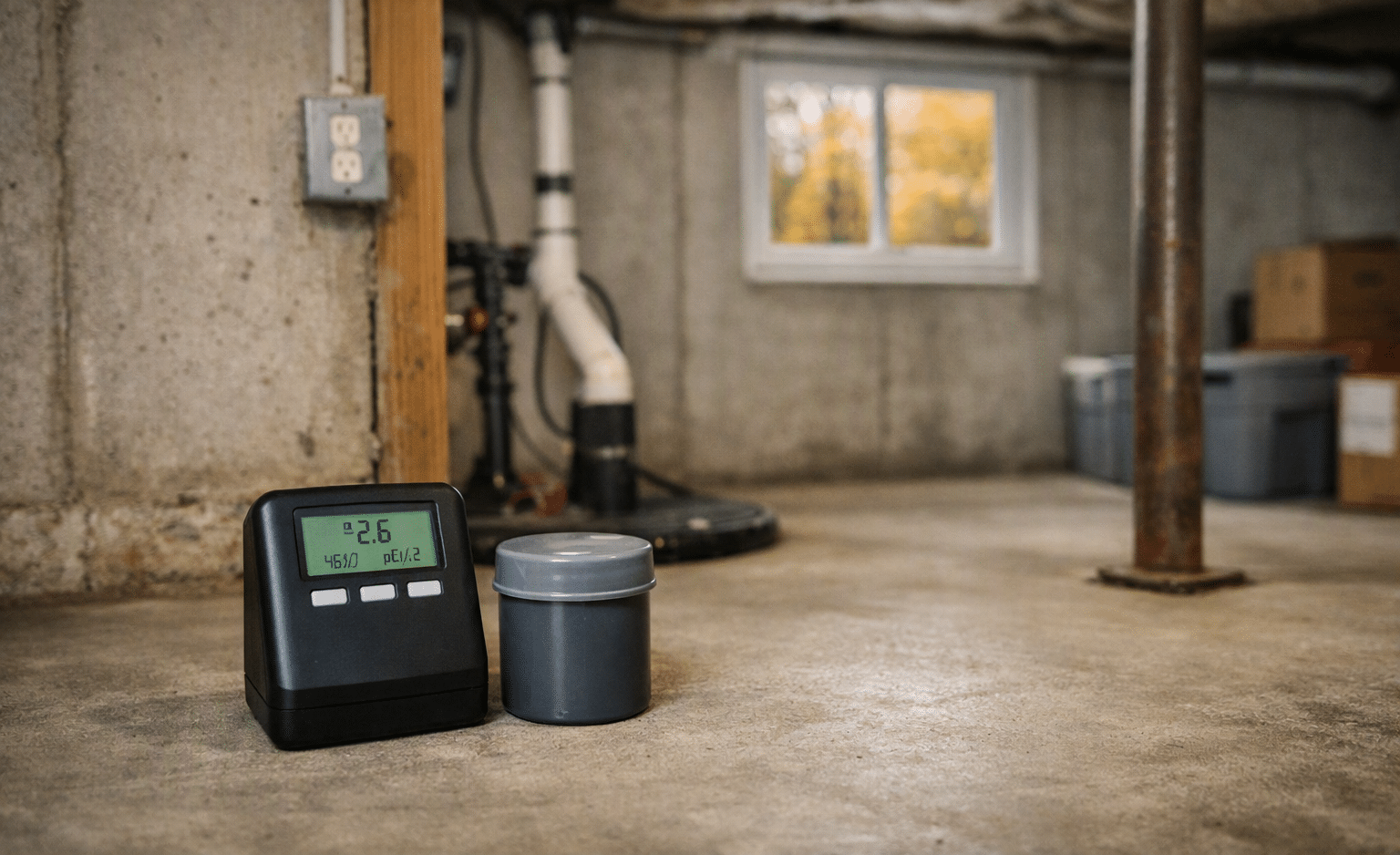
As temperatures start to ease and windows stay closed more often, homes begin to hold onto indoor air differently than they did over the summer. That shift makes early fall a practical time to think about radon testing, since radon levels are influenced by how much a home’s air is circulating with the outside. For homeowners who haven’t tested recently, or ever, this stretch of the year is a good window to get ahead of it.
Why It Matters
Radon is a naturally occurring gas that enters homes through soil contact, and it’s completely undetectable without a test, since it has no color, odor, or taste. Because exposure happens gradually over time, radon doesn’t announce itself the way many other home issues do. Testing is the only reliable way to know whether a home has elevated levels, and catching a problem early, before winter’s closed-up conditions set in, gives homeowners more time to address it without added pressure.
What Inspectors Evaluate
During a radon test, a few factors shape how the results are gathered and interpreted:
- Test placement, typically in the lowest livable level of the home
- Closed-house conditions, since accurate results depend on limited air exchange during testing
- Duration of the test, whether short-term or long-term
- Structural factors, including foundation type and any existing sump systems
- Prior test history, if the home has been tested before and under what conditions
Test Placement and Closed-House Conditions
Radon testing typically takes place in the lowest level of a home that’s regularly used as living space, since radon concentrations tend to be highest closer to the ground. For accurate results, the home needs to be in closed-house conditions for a set period before and during testing, meaning windows and exterior doors stay closed except for normal entry and exit. This is one reason early fall works well: as homeowners naturally start closing windows for cooler weather, achieving these conditions becomes easier without much extra effort.
Short-Term Versus Long-Term Testing
A short-term test typically runs for two to seven days and gives a quicker read on radon levels, while a long-term test spans more than 90 days and offers a fuller picture of average exposure throughout the seasons. Both have their place, and the right choice often depends on timing and whether a homeowner needs results quickly, such as during a real estate transaction, or is looking for a more complete long-term average.
Structural Factors That Influence Results
Foundation type plays a meaningful role in radon entry points, since radon typically moves up through cracks, gaps, and other openings in contact with soil. Homes with basements, crawlspaces, or slab foundations can each have different entry patterns, and existing sump systems or previously sealed areas can also affect how radon moves through the structure.
Seasonal Considerations
According to the EPA, nearly one in fifteen homes in the United States has a radon level that should be reduced, and levels can vary across seasons as a home’s ventilation patterns change with the weather. Testing during early fall, as closed-house conditions start to occur more naturally, tends to produce results that better reflect what a home will experience through the coming winter, when windows stay shut for extended stretches.
Homes with existing moisture concerns are also worth a closer look alongside radon testing, since basement and crawlspace conditions often relate to both issues. Our earlier post on crawlspace moisture and hidden problems in Maryland homes covers what to watch for in these lower-level spaces, which pairs well with a radon test scheduled for the same area.
When Further Evaluation Is Recommended
A few situations call for a follow-up test or a licensed radon mitigation professional:
- Results at or above the EPA’s recommended action level
- A short-term test result that seems unusually high or inconsistent with expectations
- Recent renovations affecting the foundation, HVAC system, or ventilation
- A home that has never been tested, particularly if it has a basement or crawlspace
- Plans to convert a lower level into more frequently used living space
None of these situations necessarily mean a major mitigation system is required. In many cases, a straightforward follow-up test or a targeted fix can resolve the concern.
Supporting Long-Term Maintenance and Prevention
A few simple habits help keep radon awareness part of a regular home maintenance routine. Testing every two years, or after any major renovation, keeps results current as conditions in a home change over time. Keeping a record of past test results and conditions makes it easier to track changes season to season. If a mitigation system is already in place, checking that the system’s fan and vent pipe are functioning as expected helps confirm it continues to work as intended. Scheduling a test now, before winter’s fully closed-up conditions arrive, is a straightforward way to stay ahead of it.